The Camera Was Never the Hard Part
I spent a lot of years as a photographer.
Long enough to watch photography completely transform.

I started in a world where photography required cameras, lenses, film, processing, equipment and a fair amount of technical knowledge just to get a usable photograph. Then came digital photography. Then smartphones. Suddenly almost everyone had a very capable camera with them all the time.
And I actually think that's pretty incredible.
More people photograph their lives now than probably at any other point in history. We document our families, our pets, our travels, our food, sunsets, ordinary Tuesdays and moments that would have disappeared completely a generation ago.
The frustrating part, as someone who made a living with a camera, was watching the perception of professional photography change along with it.
When the Equipment Became the Skill
There were times when I would give someone my photography prices and hear some version of:
"My friend has a really good camera."
Eventually that became:
"My friend has a really good phone."
I understood what they meant.
What became exhausting was trying to explain that the camera itself wasn't really what they were paying me for.
They were paying for everything I had learned before I ever pressed the shutter.
Light. Composition. Timing. Exposure. Lenses. Perspective. Editing. Anticipating a moment. Knowing where to stand. Knowing when something was about to happen.
And, probably more importantly, knowing what to do when absolutely nothing went according to plan.
That knowledge came from years of actually doing the work.
It wasn't about having better equipment than somebody else.
It was about experience.
Art Has Made Me Think About This Differently
Now that so much of my creative life revolves around painting, I find myself thinking about those years in photography quite a bit. Because I'm on the other side again.
I'm learning.
I can buy beautiful watercolor paints. I can buy professional brushes. I can buy 100% cotton watercolor paper. None of those things automatically make me a better painter. Believe me, I wish they did. The materials certainly matter. Good materials can make an enormous difference. But they can't replace practice.
I still have to understand how much water is on my brush. I have to understand what the paint is going to do when it hits wet paper. I have to learn color, perspective, value and composition.
I have to make bad paintings.
Probably a lot of them.
Nobody Gets Into a Car Already Knowing How to Drive
I've always thought learning a creative skill is a little like learning to drive. You don't climb into a car at five years old and instinctively understand what to do. You don't magically know at 16 either. Someone teaches you. You practice. You make mistakes. You slowly stop thinking about every individual movement. Eventually, much of it becomes instinct.
Photography became that way for me.
There are things I see through a camera that I don't consciously have to think about anymore because I've spent decades doing it. Painting isn't there yet. And that's actually one of the things I enjoy about it.
I Don't Want to Skip Learning
I see artists use tracing techniques, projectors and light tables, particularly when working with architecture. There is absolutely nothing wrong with that. They're tools, and artists should use whatever tools work for the way they create. I own a light table myself. But I've discovered that most of the time, I don't want to use it.
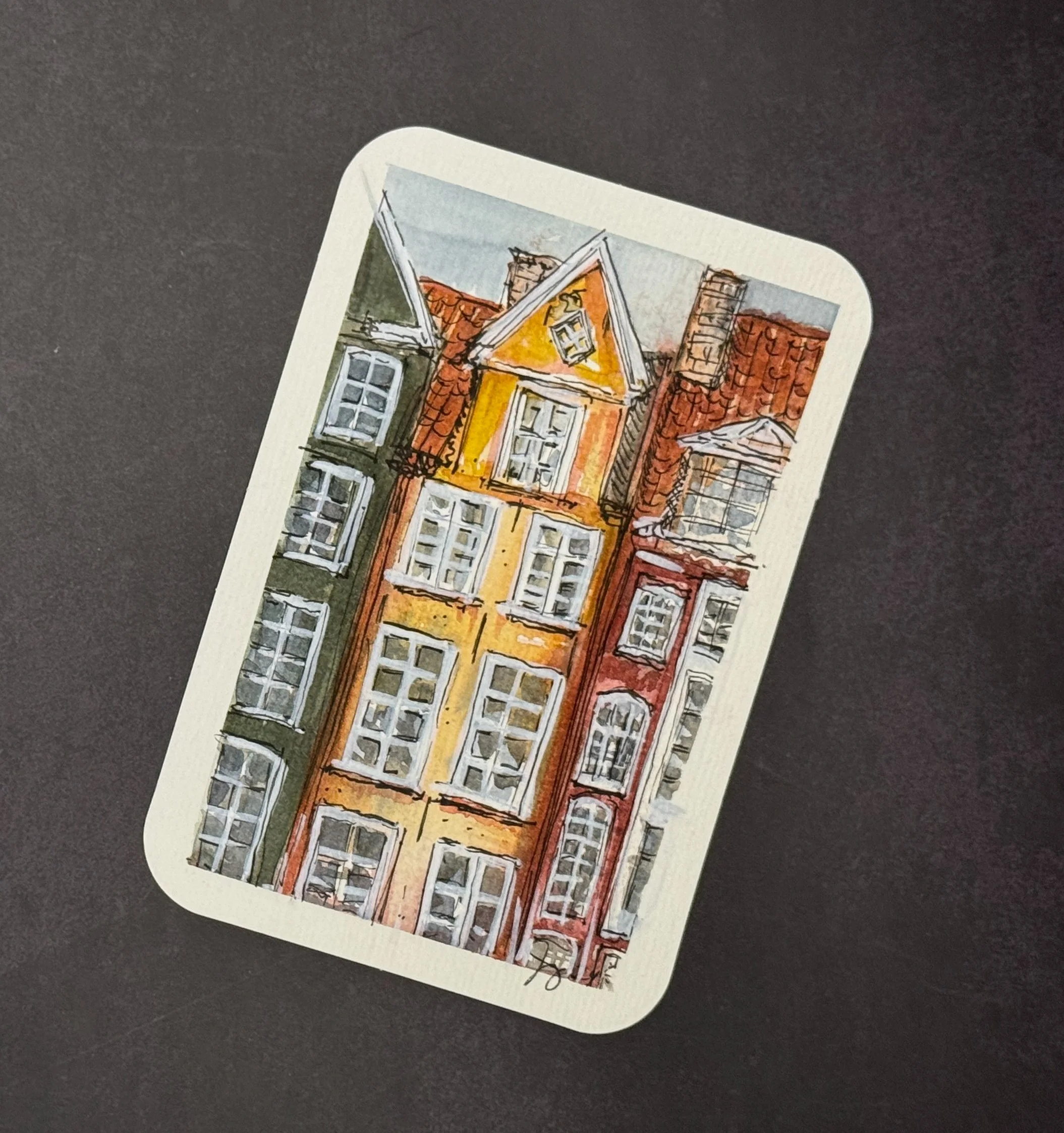
If I'm painting a house, I want to learn how to draw the house. If my perspective is wrong, I want to understand why. If the proportions look strange, I want to figure out what I'm seeing incorrectly. That's not because I think everyone should work that way. It's because I know what I'm trying to learn.
I spent years developing my eye as a photographer. Now I'm trying to develop another part of that same visual language. For me, drawing something by hand is part of the exercise. I don't just want to know how to reproduce what I'm looking at. I want to get better at seeing it.
Photography Didn't Go Away
I also don't think I've stopped being a photographer. I've just changed my relationship with photography. The kind of photography I'm most interested in doing right now is landscape photography. And I don't need a client for that. I can take my camera somewhere simply because I want to photograph what I'm seeing. There doesn't have to be an invoice attached to it. Nobody has to approve the photographs. Nobody has to question what they cost. I can just make photographs again.
There's something incredibly freeing about that.
I also loved storytelling photography—the kind of photography where you're documenting people, places and experiences and trying to tell a larger story through a collection of images. I think that part of my photography will return too. It'll probably happen when I begin traveling again.
For now, it can wait.
Being a Beginner Again
Maybe that's one of the stranger things about this stage of my creative life. I have decades of experience in one creative field while simultaneously feeling like a complete beginner in another. And instead of being frustrated by that, I'm trying to embrace it.
Am I the best painter?
No.
I've made some paintings I'm incredibly proud of. I've made others that taught me what not to do next time. But I'm beginning to recognize something in my work that feels like mine. That's what interests me now. Not whether I can paint exactly like another artist. Not whether I can find a shortcut that makes everything technically perfect. I want to know what happens if I keep practicing. Because I've already seen what decades of practice can do.
Photography taught me that.
The Tool Was Never the Point
Cameras will continue getting better.
Phones will continue getting better.
Art materials and technology will continue changing. That's not a bad thing. More people having access to creative tools means more people have the opportunity to create. But having access to the tool is only the beginning. The interesting part is what happens after you've used it a hundred times.
A thousand times.
Ten thousand times.
It's the mistakes you make. The things you start noticing. The decisions you eventually make without consciously realizing you're making them. It's developing your own way of seeing. That's what photography gave me. And now, with painting, I'm getting to experience that process all over again. Maybe that's why I'm not in much of a hurry to arrive anywhere. I'm still learning. I'm still experimenting.
And I'm starting to realize that figuring out what kind of artist I want to be might be the most interesting part of the whole thing.